SQL is a Structured Query Language. Its main function is to help access and manipulate database.
SQL statements execute tasks such as update data on a database, or retrieve data from a database.
Examples of SQL: Oracle, Sybase, Ingres
References:
http://www.w3schools.com/sql/default.asp
http://sqlcourse.com/intro.html
Sunday, April 5, 2009
Importance & Role of Metada
Metadata is a structured information that facilitates the understanding, characteristics, and management usage of data. The metadata alters with the type of data and context of use.
It is a vital component of Database, which makes sure that resources will be well stored and be accesible anytime in the future.
References:
http://www.niso.org/publications/press/understandingMetada.pdf
http://en.wikipedia.org/wiki/Metada
It is a vital component of Database, which makes sure that resources will be well stored and be accesible anytime in the future.
References:
http://www.niso.org/publications/press/understandingMetada.pdf
http://en.wikipedia.org/wiki/Metada

Structure of DBMS

1. DDL Compiler - Data Description Language compiler processes internal specifications in the DDL. It uses metadata information such as the name of the files, data items, storage details of each file, mapping information and constraints etc.
2. DML Compiler and Query optimizer - The DML commands such as insert, update, delete, and retrieve from the application program. Then, they are sent to the DML compiler to be set into object code for database access. The object code is optimized to perform a query by the query optimizer and then sent to the data manager.
3. Data Manager - The Data Manager is a vital software component of the DBMS also knows as Database Control System.
Example of DBMS software: Oracle, Microsoft SQL Server, MySQL
References:
http://74.125.93.104/search?q=cache:VIHaso1VOQkJ:www.cs.uiuc.edu/class/fa06/cs511/4-arch.ppt+dbms+architecture&cd=2&hl=en&ct=clnk&gl=ca
http://www.dbmsbasics.blogspot.com/2008/02/structure-of-dbms.html
http://www.jucs.org/ujs/jucs/Journal/Volume%208/Issue_8_6/efficient_content_based_and/images/fig4.gif
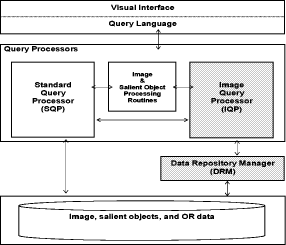
Advantages of DBMS
1. Flexibility: All programs are independent and any unrelated data can be added or deleted at anytime without altering the program or there are amendments in the physical storage.
2. Fast response to information access: As data is integrated into a single database, complex requests can be managed efficiently.
3. Multiple accesses: Data can be accessed in different ways with the Database software; for example: various key fields
4. Lower user training costs: Users often find it easier to learn such systems which would increase user productivity. Therefore training costs may be reduced.
5. Less storage: All data items need to be stored only once, thus it eliminates the storage of redundant data.
References:
http://www.blurtit.com/q358487.html
http://db.cs.berkeley.edu/topics/lecs/dbprimer/sld011.htm
2. Fast response to information access: As data is integrated into a single database, complex requests can be managed efficiently.
3. Multiple accesses: Data can be accessed in different ways with the Database software; for example: various key fields
4. Lower user training costs: Users often find it easier to learn such systems which would increase user productivity. Therefore training costs may be reduced.
5. Less storage: All data items need to be stored only once, thus it eliminates the storage of redundant data.
References:
http://www.blurtit.com/q358487.html
http://db.cs.berkeley.edu/topics/lecs/dbprimer/sld011.htm
Introduction of DBMS
A DBMS is a group of software programs that regulates the organization, storage, management, and retrieval of data in a database.DBMS are divided into their data structures/types. They are prewritten programs which are stored and updated, ready to retrieve a database.
The DBMS processes requests for data from the application program and orders the operating system to send the right data. The information systems can be computed easily while the organization’s information requirements change.
History
In the 1960's - NAVIGATIONAL DATABASE
As computers evolved, interest in a standard began to grow. Charles Bachman, author of Integrated Data Store (IDS), founded the "Database Task Group" within CODASYL. They created and standardized COBOL. In 1971 they introduced the "Codasyl approach", and soon there were some commercial products derived from it available. The Codasyl approach was integrated into a large network and used a "manual" navigation of a linked data set. However, it had no concept of "find" or "search". At that time, such an operation was too expensive to see the issue as a limitation.
http://en.wikipedia.org/wiki/Database_management_system
The DBMS processes requests for data from the application program and orders the operating system to send the right data. The information systems can be computed easily while the organization’s information requirements change.
History
In the 1960's - NAVIGATIONAL DATABASE
As computers evolved, interest in a standard began to grow. Charles Bachman, author of Integrated Data Store (IDS), founded the "Database Task Group" within CODASYL. They created and standardized COBOL. In 1971 they introduced the "Codasyl approach", and soon there were some commercial products derived from it available. The Codasyl approach was integrated into a large network and used a "manual" navigation of a linked data set. However, it had no concept of "find" or "search". At that time, such an operation was too expensive to see the issue as a limitation.
In the 1970’s – RELATIONAL DATABASE
Edgar Codd was not satisfied with the Codasyl approach. Therefore, he developed the navigational model further to introduce the “search” facility which turned out to be increasingly important. In 1970, he sketched a number of papers that briefly described a new approach to database construction. It eventually successfully attained to the groundbreaking “A Relational Model of Data for Large Shared Data Banks”.
Codd described a new system to store and work with large databases. Codd's idea used a "table" of fixed-length records while Codasyl’s idea was that records were being stored in some sort of linked list of free-form records. The relational model solved the “sparse” database problems by splitting the data into a series of normalized tables, with optional elements being deleted out of the main table only if needed.
End 1970s SQL DBMS
IBM introduced a rough version in the early 1970’s where all of the data for a record did not have to be stored in a single bulk. With customer’s feedback, they were able to implement a standardized query language (SQL). As Codd’s relational model was superiorly functional, it pushes IBM to excel in the creation of System R (SQL/DS), and, later Database 2 (BD2).
In the mid-70’s, Mimer SQL was developed based on Codd's paper at Uppasala University in Switzerland. Subsequently, in the early 1980s, Mimer created the transaction handling for high robustness in applications which was then implemented on most other DBMS.
References:
http://en.wikipedia.org/wiki/Database_management_system
Subscribe to:
Comments (Atom)